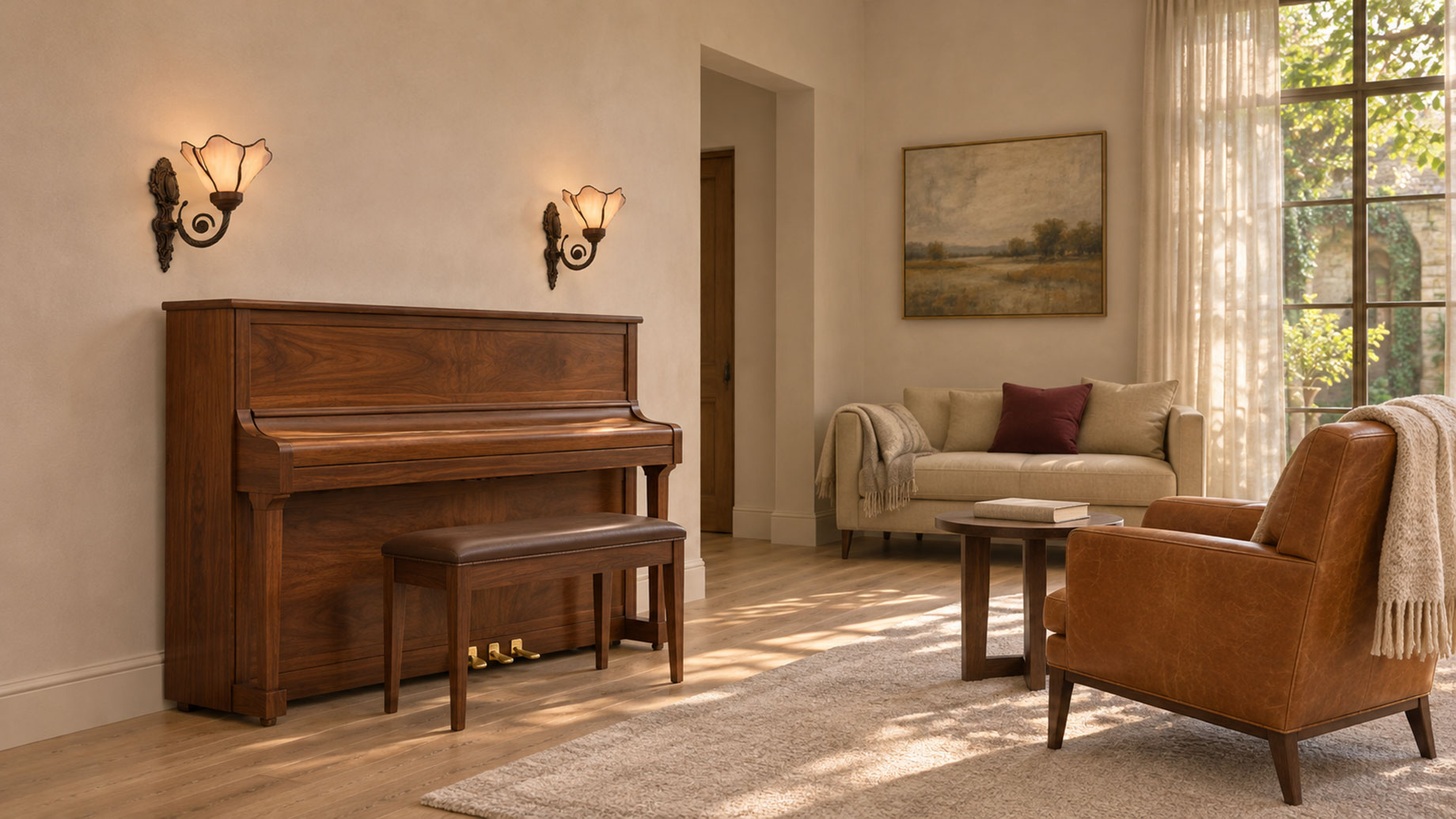
A piano changes the way a sitting room is arranged. It introduces a substantial piece of furniture, a place for someone to play and a reason for other people to gather. Yet the surrounding interior can easily become too formal: an instrument against a bare wall, a bench positioned precisely in front and seating that feels disconnected from everything else.
Wall lighting offers a way to bring these elements together. Stained glass adds color and a human scale to the wall above or beside the instrument, while leaving the floor available for seating and movement. In a contemporary home, a small amount of ornamental detail can make a music corner feel personal without turning the room into a period interior.
Arrange the Room Around Playing and Listening
Begin with the instrument and the people who use it. An upright piano needs room for the bench to move and for the player to sit down comfortably. A nearby armchair should not block that movement, and a side table should remain outside the route between the instrument and the rest of the room.
For the instrument’s location, follow its manufacturer’s guidance and seek advice from a piano technician where necessary. Once that position is established, arrange the seating so that listening and conversation both feel natural. An armchair angled toward the piano and a sofa facing into the room often create a more relaxed relationship than a row of seats directed at the player.
Only then decide which wall needs lighting. A pair of fixtures can frame the piano, but the arrangement should also make sense when nobody is playing. From the sofa, the illuminated wall should feel like part of the sitting room rather than a small stage waiting for a performance.
Choose a Shape That Relates to the Instrument
An upright piano presents a broad horizontal top, strong vertical sides and a long keyboard line. A curved glass shade can soften those straight edges. Alternatively, a geometric shade can repeat the instrument’s structure in a quieter way.
When comparing Tiffany wall sconces, look at the complete silhouette, including the backplate and arm. A compact petal-shaped shade on a curved support creates a different effect from a wide half-bowl fitting. The amount of visible metal matters too, particularly against a pale wall where an ornate backplate will remain noticeable even with the light switched off.
Keep the dimensions in proportion to the wall and piano. Small fixtures can provide a deliberate accent without competing with the instrument. Larger shades may need more space around them, especially if artwork is planned between the pair. Check overall height and projection as well as shade width before settling on a design.
Compose the Wall Without Filling Every Gap
Symmetry is useful above an upright piano because the instrument provides a clear centerline. It is also easy to overwork. A pair of sconces, a large painting, several framed photographs and decorative objects along the piano top can leave very little visual rest.
Try a simpler arrangement first: two lights and one modest artwork, or a pair of lights with an otherwise open wall. Allow the glass to be the most detailed element in that composition. If the room already contains a substantial art collection, a less elaborate shade may sit more comfortably beside it.
Use paper templates to establish the relationship between the fixtures, artwork and instrument. Measure the mounting position separately from the apparent center of the shade; a curved arm can place the glass above and to one side of the electrical connection. Confirm the final positions with the installer before decorating.
Leave room for any piano lid or music-rest movement, and for maintenance access. Lighting should fit around the instrument’s practical requirements rather than restrict them.
Use Glass Color to Connect the Room
Stained glass need not produce an intensely colorful interior. Pale cream, soft amber or muted pink can introduce warmth into a room dominated by plaster, timber and neutral upholstery. More saturated blue or green can become a stronger accent, particularly against a light background.
As you explore Tiffany wall lights, compare photographs of the shades both illuminated and unlit where available. A fitting remains part of the room during daylight, when the glass can appear quite different. Choose a design whose daytime appearance works with the furnishings as well as one whose evening glow appeals to you.
Repeat one supporting color elsewhere rather than matching the whole palette. A muted green chair might relate to foliage-colored glass, while a warm neutral rug can complement amber tones. Dark metalwork can sit naturally beside walnut furniture without requiring every handle, frame and table base to have an identical finish.
In a contemporary setting, restraint gives the decorative lighting more presence. Plain curtains and generously scaled upholstery allow a finely detailed shade to remain distinctive.
Give Sheet Music Its Own Light
The lighting that makes a room inviting may not illuminate a score comfortably. Wall sconces can provide atmosphere around the instrument while leaving the music stand in shadow or placing reflections across a glossy surface.
Assess reading light from the player’s normal seated position, with the music rest in use. A separate, appropriately positioned piano light may be needed to illuminate the pages and keyboard. Check that its light is useful to the player without shining directly toward listeners.
This distinction also helps with the rest of the room. Someone reading in an armchair may need a nearby task lamp even when the wall lights are on. There is no need to make the decorative fixtures excessively bright in an attempt to serve every activity.
If several lights will operate together, compare their appearance in the actual room. The aim is a comfortable balance between the illuminated glass, the player’s working area and the seating—not a collection of unrelated bright spots.
Plan for the View from Every Seat
A wall light that looks attractive while standing can be less comfortable from a low sofa. Upward-facing shades may reveal their bulbs from certain angles, while polished piano surfaces can reflect a light source that is otherwise outside the viewer’s direct sightline.
Before installing Tiffany wall lamps, consider the views from the piano bench, sofa, armchairs and doorway. Ask for additional product photographs or mounting information if the shade opening and bulb position are unclear. Moving a proposed fixture slightly may resolve a reflection more effectively than simply choosing a dimmer bulb.
Discuss controls with the electrician at the same time. Separate control of decorative and task lighting allows the room to change between practice, conversation and quiet listening. If dimming is desired, confirm compatibility between the fixture, light source and control rather than assuming every combination will work.
Keep the Room Ready for Ordinary Evenings
A successful music room should be easy to use without preparation. Keep a suitable place for scores, provide a side table for drinks away from the instrument and leave the piano bench free of cushions or decorative objects that must be moved before playing.
Choose wall-light positions that remain accessible for cleaning and bulb replacement. Have hardwired fittings installed by an appropriately qualified electrician, following the product instructions and local requirements. Keep the fixture details for future maintenance.
The finished room can be composed without feeling precious: a comfortable chair turned toward the piano, a clear space for the player and a pair of glass shades that give the wall color after dusk. Those decisions make music part of everyday living, while allowing the room to remain an inviting place to sit when the keyboard is closed.
