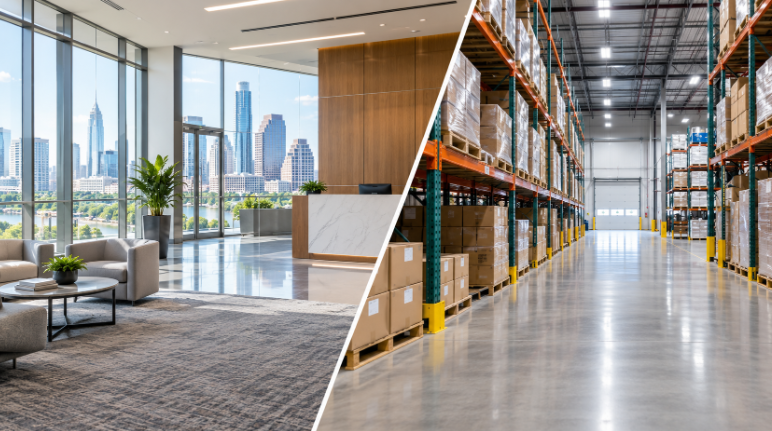
Austin property owners increasingly hold mixed portfolios. An office floor downtown. A distribution facility near the airport. Retail somewhere between. Each one needs a different cleaning standard, and providers such as NAE Cleaning Solutions price them very differently for good reason.
Treating them the same is where asset value quietly erodes.
Why Cleaning Is a Property Asset Issue
Most owners file cleaning under operating costs, but that undersells it. Floors, glass, fixtures and finishes cost real money to install, and cleaning is what keeps them from wearing out early.
Neglect doesn’t take a day off. It compounds. A floor that misses its maintenance cycle does not stay level. It degrades toward replacement.
Replacement costs many multiples of maintenance. That gap is the entire argument.
Warehouse Cleaning Protects Different Things Than Office Cleaning
The two facility types fail in opposite directions.
An office fails on appearance first. Dusty glass. Scuffed baseboards. Tired carpet.
A warehouse fails on function first. Dust in racking. Debris in traffic lanes. Floor coating wearing through under forklift turns.
Nobody tours a warehouse looking for polish. They look for a floor that holds up and aisles that are safe.
So the standards diverge sharply:
- Office priorities. Glass, carpet, restrooms, and shared surfaces.
- Warehouse priorities. Floor coating, dust control, loading areas, and high-level racking.
6 Cleaning Standards That Protect Commercial Property Value
These apply across a mixed portfolio, whatever the building type:
- Written frequencies per area. Not a blanket schedule. Each zone gets its own interval.
- Approved products per surface. Coated glass, sealed concrete, and stone all react differently to chemistry.
- Documented floor care cycles. Stripping, sealing, and recoating on a calendar, not on complaint.
- Condition reporting. Crews flag damage during routine visits, before it becomes a repair.
- Scheduled deep cleaning. Vents, high-level dusting, and upholstery on a quarterly cycle.
- One accountable vendor contact. A name, not a general inbox.
None are expensive. All are routinely missing from portfolio cleaning contracts.
Why Office Cleaning Standards Affect Lease Renewals
Tenants renew for reasons beyond rent. Building condition sits near the top.
This is easy to underestimate. Rent gets negotiated once a year. The condition of the lobby is experienced every single morning.
Over the length of a lease, what tenants see every day counts for a lot more than the one rent conversation each year.
People who come to look at a space judge the common areas before they ever see the suite. The lobby, the elevators, the restrooms and the hallways are doing that job for you.
Property managers who look after office cleaning in Austin tell the same story: when the shared areas look kept up, people see the whole building differently on a tour.
It goes the other way too. A shabby hallway can ruin a beautiful suite in seconds.
Warehouse Floor Coatings and the Cost of Waiting
Of everything in a property, industrial floors are usually the most expensive to replace.
A sealed concrete floor can take a lot of weight. Once the seal wears through, though, the concrete underneath starts drinking up oil, chemicals and water.
After that, cleaning won’t save it. The floor has to be ground down and resealed, or patched if it’s really bad.
Regular scrubbing and recoating keeps the slab going much longer. It’s dull, predictable spending, and it keeps you from the kind of bills nobody saw coming.
.
Restroom Cleaning Drives More Complaints Than Anything Else
In offices and warehouses alike, restrooms get far more complaints than anything else. They’re also the cheapest thing to fix, because the trouble is usually how often they get cleaned, not how well.
- The soap or paper runs out by mid-afternoon.
- The floor gets mopped once a day in a building with heavy traffic.
- The sinks and toilets get cleaned, but the grout and the stall partitions don’t.
One extra visit around noon fixes most of it. To a property manager that’s a small cost next to the tenant complaints it stops.
Dust Control Is a Warehouse Cleaning Requirement
People write dust off as cosmetic in industrial space. It isn’t.
- It lands on the inventory and can damage the goods.
- It piles up on the high racking, where nobody can reach it and nobody looks.
- It clogs the vents and the light fixtures, so the air and the light get worse.
- In some operations it can catch fire.
Cleaning up high takes a lift, so book it well ahead. Last-minute requests cost a lot more.
Writing One Cleaning Specification Across a Mixed Portfolio
Owners holding several asset types often run several disconnected cleaning arrangements. That creates gaps.
A single specification with building-specific sections works better. Keep the structure identical. Vary the content by asset.
Each section should answer four questions. What areas? At what frequency? With which products? Reported how?
Consistent structure makes comparison possible. You can see which building is underserved, and which is overspending.
How Often to Review a Property Cleaning Contract
Most portfolio cleaning contracts run untouched for years. Buildings change faster than that.
An annual review takes under an hour per property. Check four things:
- Has occupancy changed enough to shift cleaning frequency?
- Have any finishes or floor systems been replaced?
- Is the condition reporting actually arriving?
- Does the spend still match the service delivered?
Owners who run this review usually find one building overserved and another quietly neglected.
Conclusion: Cleaning Standards Protect Austin Property Value
Cleaning looks like housekeeping on a budget line. In a property portfolio it functions as asset protection.
Office buildings hold tenants through visible condition. Warehouses hold value through floor and dust management.
Both degrade quietly when the specification is vague or inherited.
Write it properly once, vary it by building type, and review it annually. The spend barely changes. The outcome does.
Commercial Property Cleaning FAQs
How does commercial cleaning affect property value?
Floors and glass last years longer when someone looks after them. A building with a cleaning record also looks cared for, and a buyer or lender can tell when it isn’t.
Should warehouse and office cleaning use the same contract?
One contract is fine, as long as the warehouse and the offices get their own sections. They don’t need the same schedule or the same products.
How often should warehouse floors be cleaned?
Sweep the main lanes every day. Scrub them weekly if the traffic is heavy, monthly if it isn’t. Once the shine is gone, it’s time to recoat. A worn seal lets the concrete soak up every spill.
What cleaning standards do commercial tenants notice most?
The lobby, the elevators and the restrooms. Everyone walks through those daily, so a grubby restroom is what a tenant brings up when the lease is up.
Is dust control really necessary in a warehouse?
Yes. It settles on the stock and clogs the lights and vents, and sometimes it’s a fire risk. Cleaning up high takes a lift, so schedule it ahead.