A finished luxury home carries thousands of individual components, installed by dozens of trades over a four-to-six-month build. Any one of them can be the thing a homeowner is arguing about in year three. That’s the uncomfortable math problem sitting under every closeout walk.
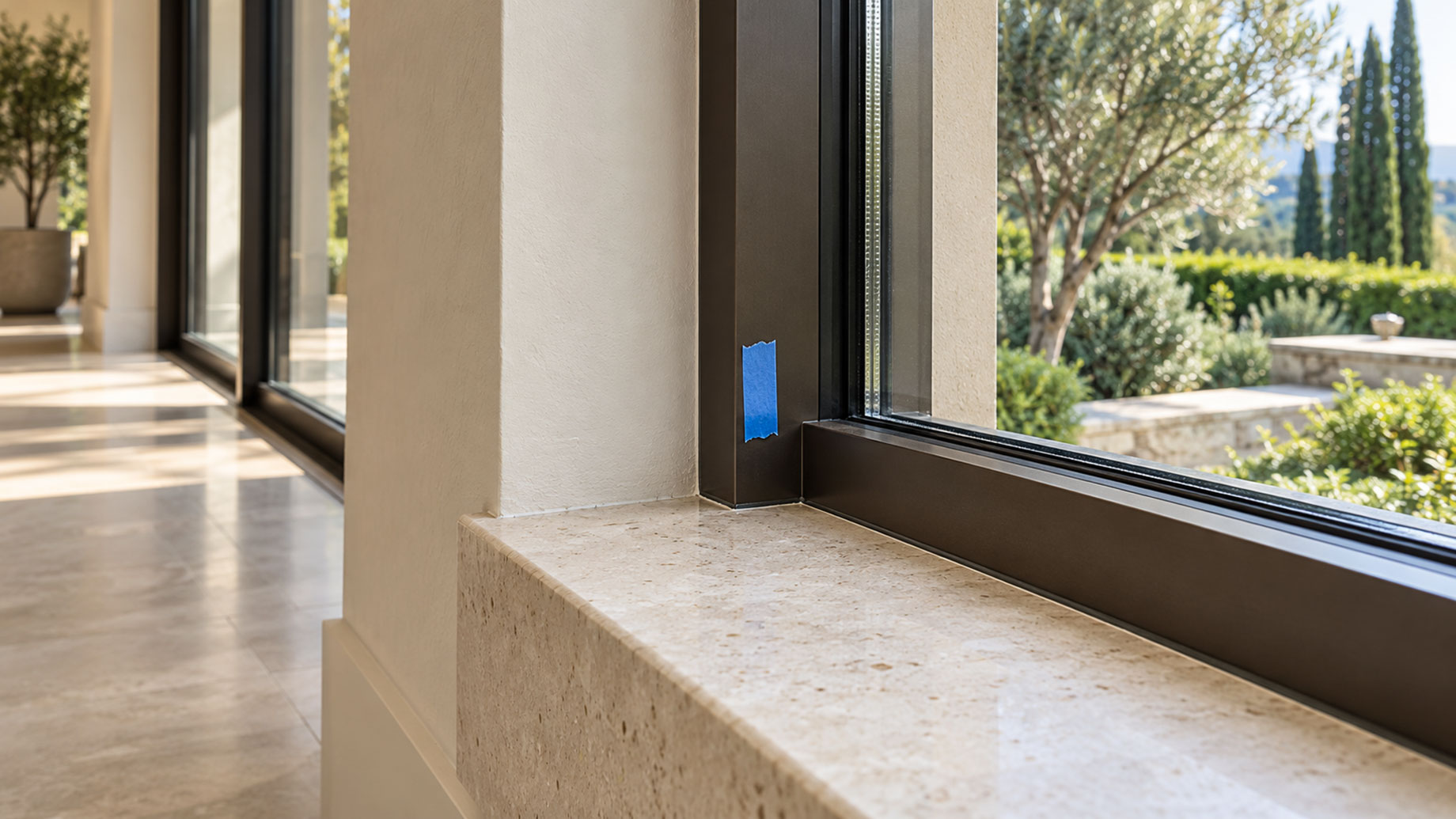
The small blue-taped item nobody fought about on the punch list has a strange habit of coming back as a warranty claim with a six-figure number attached. The chain is almost always traceable, and it almost always runs through one specific trade day.
The Flashing Detail Nobody Argued About
Picture a composite case the industry sees in different shapes every year: a custom residence, a rear wall of tall windows above a cantilevered deck, and a punch list closed out on time. One item on that list reads something like “touch up sealant at left mullion, exterior.” The GC signs it off. The owner moves in. Nobody thinks about it again.
Three winters later, interior drywall below those windows starts to bubble. A moisture meter confirms what the stain already suggested. By the time the forensic consultant pulls finishes, the sheathing behind the mullion is often badly stained, the sill pan may never have been fully lapped, and the sealant line that got “touched up” can turn out to have been covering a flashing detail that was wrong from the day it was installed.
That single sentence on a punch list is now the center of a claim. The question the lawyers, the insurer, and the forensic engineer all ask next is the same one: which day did this get built, and who was on site?
Water Finds the One Detail That Was Rushed
Water intrusion is the slow engine behind most residential defect litigation. It is also the slowest to show itself, which is why it so often lands outside the one-year workmanship window and inside the longer structural tail. A homeowner does not see a bad kickout at year one. They see a ceiling stain at year three.
The pattern repeats across price points, and luxury homes amplify it. Tall glazing, long parapet runs, flush decks over conditioned space, unusual cladding on complex geometry: every one of those features multiplies the number of transitions a water-management detail has to survive. One rushed afternoon at a parapet-to-wall junction can sit invisible behind stucco for years.
Carrying the right builder insurance and risk-management support is how a builder stays protected across the long stretch between the day a bad detail was installed and the day it starts leaking into a finished room.
The Clock Starts at Substantial Completion, Not at Discovery
Owners are routinely surprised to learn that the warranty clock, and the statute-of-repose clock behind it, generally starts ticking at substantial completion rather than the day they noticed the problem. The useful life of a claim is partly a function of when a certificate got signed, not when a stain appeared.
Repose periods for residential construction defects vary significantly by jurisdiction, and several have shortened in the last few years. Any owner or builder reading this should check their own state’s current statute before assuming anything about timing. The practical point is simpler. The day the punch list closed is a legal event, not a formality.
The Trade Day Is the Real Piece of Evidence
When a defect case gets serious, the investigation collapses down to a specific window of days on the schedule. The forensic consultant wants the sequence: who flashed, who inspected, who closed the wall, and in what order.
The insurer wants the daily reports, the inspection photos, the delivery tickets, and the subcontractor sign-offs for that window. If those records exist and are clean, the case has a shape. If they do not, every party is reconstructing from memory.
This is where the quiet discipline of jobsite documentation earns its keep years after the fact. The things worth keeping are mostly obvious once a claim lands, and mostly ignored when the schedule is tight.
What Owners and Builders Should Do at Closeout
The federal consumer guide on new-home warranties is a useful starting point for any owner about to accept delivery of a custom house, because it lays out what builder warranties typically do and do not cover and how disputes usually get resolved. Reading it before closeout is cheaper than reading it after a leak.
For the builder, the discipline is narrower and harder. The final two weeks of a project are the most important documentation window of the whole job, not the most tedious. A punch list is not a to-do list. It is the record a future claim will be built on or defended with. Write it like someone will read it under oath, because on a long enough timeline, someone might.
The item that becomes a warranty claim three years later is almost never a mystery once the wall is open. It was a specific detail, installed on a specific day, by a specific crew, and signed off in a specific line of a specific document. The homes that weather their warranty tail well are the ones where that paper trail is boring and complete.
