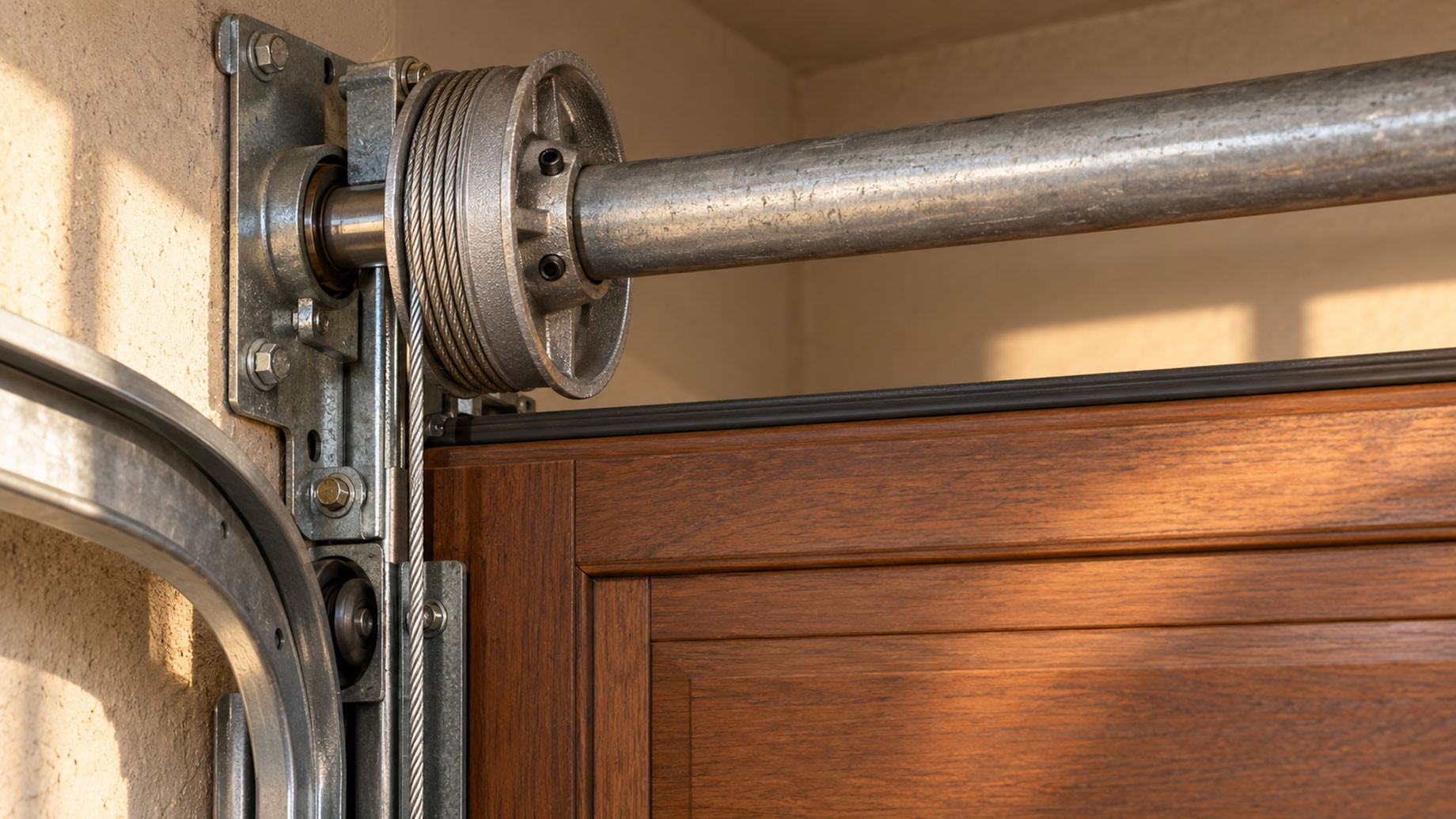
A custom garage door on a luxury home is rarely a plain sheet of steel. It may be a full-width carriage-style door in solid wood, a tall run of glass and aluminum panels, or an oversized double that exceeds standard dimensions. Almost all of that weight is managed by two thin steel cables that most owners have never looked at.
This article takes up the questions buyers ask when one of those cables frays or snaps: why it happens on heavy doors, what the warning signs are, and why the repair is not a weekend project. As of late October 2026, with this year’s monsoon season behind us, it is also a practical moment to look at the hardware before the busy holiday months.
Is garage door cable replacement a DIY job or a task for a licensed pro?
Garage door cable replacement belongs with a licensed professional, because lift cables are tied into a counterbalance system that stores a great deal of energy. The cables run from the bottom corners of the door up to drums on the spring shaft, and the springs are what keep them taut. Releasing a cable or its bracket without controlling that stored tension can send hardware, or the door itself, moving suddenly.
I Love It Garage Doors is a family-owned garage door repair and installation company based in Phoenix, Arizona, licensed under Arizona ROC #359771, that offers same-day repair, warrantied repairs and installs, and 24 hour emergency service across the Phoenix Valley. The company lists professional garage door cable replacement alongside spring repair, roller replacement and panel replacement, a grouping that makes sense because those parts wear together and share the same load.
The safest habit mirrors the guidance for broken springs: “Do not try to lift a garage door with a broken spring unless it is absolutely necessary, and never stand under the door while it is unsupported.” A snapped cable can leave one side of a door hanging crooked, so the same caution applies. The sensible response is to leave the door where it is and call a licensed contractor.
Why do lift cables fail on heavy custom doors?
Cables fail on heavy doors because every opening and closing puts more load on each strand of steel. A lightweight steel door and a thick wood or glass door can share the same basic cable layout, but the heavier door asks that cable to hold far more. Over thousands of cycles the strands fatigue, rub against the drum and eventually let go.
Glass and aluminum doors deserve a separate mention. They look light, but full-view glazing in a metal frame adds up quickly, and the cables behind that sleek appearance still carry the full load.
Several other factors compound the problem on oversized doors:
- Width and height: a wide door twists if one side lags, loading one cable harder than the other.
- Added weight: windows, decorative hardware and wood overlays add load the original balance may not have been set for.
- Weakened springs: when a spring loses strength, the cables carry more than they were meant to.
- Poor seating: a cable that slips out of its drum groove can kink and wear quickly.
- Daily use: a main-entry door cycles far more often than a door that guards a storage bay.
DASMA, the Door and Access Systems Manufacturers Association, is the North American trade association for garage door and opener manufacturers and publishes technical data sheets on door safety and wind load. Owners of oversized doors can use that kind of reference when they ask an installer how a door’s weight and balance were accounted for.
What warning signs show up before a lift cable snaps?
Fraying, uneven closing and visible slack are the usual early warnings. Look for stray strands near the bottom brackets, rust or discoloration along the cable, a cable hanging loose near the drum, or one side of the door sitting higher than the other. Fraying near the drum is easy to miss from the floor, so a flashlight and a slow look along both sides is worthwhile. Keep hands off the cable and bracket while looking. Any of these signs is worth a visit before the cable gives out completely.
If the door suddenly feels wrong, one simple check is available. “With the door fully closed, pull the red emergency release cord and carefully try lifting the door by hand. If it feels extremely heavy or will not move, do not force it. The spring may be broken.” Treat that result as a reason to stop using the door and call a licensed professional.
While you are inspecting, the US Consumer Product Safety Commission (CPSC) advises testing a garage door opener’s automatic reversing feature regularly by placing a 2×4 board flat on the floor in the door’s path. That test covers the opener rather than the cables, yet it fits naturally into the same inspection.
How do cable problems compare with other common failures?
A frayed cable calls for a prompt visit, a snapped cable or a broken spring means the door should stay put, and worn rollers are the least urgent of the group. The table below lays out the same comparison.
| Problem | What you notice | Urgency |
|---|---|---|
| Frayed lift cable | Loose strands near the bracket or drum | Book a visit soon |
| Snapped lift cable | Door hangs crooked or jams | Stop using the door |
| Broken spring | Door feels extremely heavy | Stop using the door |
| Worn rollers | Grinding or shaking while moving | Routine service |
Cables and springs share the same load, so trouble with one often points to the condition of the other. That is why a careful technician looks at the whole counterbalance system instead of only the part that failed. A snapped cable can also damage the door panels as the door shifts, which is a further reason to book a visit at the first sign of fraying.
What should a Phoenix homeowner ask before hiring someone?
Start by confirming the contractor’s license. The Arizona Registrar of Contractors (ROC) licenses contractors in Arizona, and homeowners can look up a contractor’s ROC license number on the ROC website before hiring. A short list of questions covers most of the ground:
- Ask for the ROC license number and look it up yourself.
- Confirm the company is licensed and insured.
- Ask whether repairs and installs are warrantied, and request the terms in writing.
- Have the technician explain the options before work starts, including whether springs or drums should be addressed alongside the cable.
- Ask whether there are any trip charges, and be cautious about pressure or scare tactics.
I Love It Garage Doors grew out of its owners’ years working behind the scenes in the garage door industry, where they saw customers misled, upsold and overcharged. Co-Owner Dana McNelis runs day-to-day operations and follows up personally after every job, while Co-Owner Amelia works directly with customers. In the owners’ words: “No scare tactics, no price games, just solid work done right the first time.” (Dana McNelis and Amelia, Owners, I Love It Garage Doors)
When is the best time to inspect a heavy door in the Phoenix Valley?
Late autumn is a sound time, once the summer storm season has passed. The National Weather Service defines Arizona’s monsoon season as June 15 through September 30, so the 2026 season has closed. Summer heat is hard on moving hardware, and a post-season check can catch wear before it turns into a failed cable on a busy morning.
Owners in Scottsdale, Paradise Valley and Fountain Hills often have oversized doors that deserve an in-person look rather than a phone quote. Asking about a free diagnosis and same-day availability helps compare contractors if a cable has already failed.
A lift cable is a small part with a large job, and on a heavy custom door the margin for error is thin. Leaving the replacement to a licensed contractor protects the door, the garage and the people who walk through it every day.
