By a furniture and design industry contributor. You see a piece of furniture online or in a showroom and experience a moment of sticker shock. The price seems astronomical compared to mass-market alternatives. It is easy to assume the difference is just brand markup or exotic materials. But the real cost of furniture isn’t just the initial purchase. It is the frustration of a piece that arrives damaged, the disappointment of cushions that sag after a year, or the slow realization that the scale is completely wrong for your space.
Investing in your home is a significant financial decision. With a median household income of more than $90,000 in the city, as reported by the U.S. Census Bureau, choosing foundational pieces requires careful evaluation. The process involves looking past the catalog photo and understanding the substance behind the style. Visiting well-curated showrooms is a critical step. The best high end furniture stores denver offer more than just products; they provide spatial planning, material education, and logistical expertise that protect your investment.
Quick answer: The value of high-end furniture is found in its construction, material integrity, and the quality of service that surrounds it. Vetting a supplier means asking specific questions about joinery, fabric rub counts, delivery logistics, and post-sale support to ensure a piece will last for decades, not just a few seasons.
What’s inside
· Is High-End Furniture a Good Financial Investment?
· How Can You Spot Quality Construction Before You Buy?
· What Should I Ask About Materials and Sourcing?
· Frequently Asked Questions
Is High-End Furniture a Good Financial Investment?
Yes, when you evaluate it based on total cost of ownership over decades, not just the initial price. A well-made piece of furniture avoids the recurring replacement costs, repair fees, and environmental waste associated with disposable, mass-market items. It becomes a lasting asset rather than a short-term expense.
The financial context for any major purchase is important. According to the U.S. Bureau of Labor Statistics, average annual expenditures for a U.S. consumer unit are around $78,535. Furnishings represent a fraction of that, but it is a significant one where choices have long-term consequences. A poorly made sofa that sags in two years or a dining table with a veneer that peels is not just a functional failure; it is a failed investment that requires you to spend again.
This is especially true in a market like Denver. With just under half of housing units being owner-occupied, per the U.S. Census Bureau, many residents are making long-term commitments to their properties. In a city where property itself is a primary asset, the items you fill it with should also be viewed through a lens of durability and value retention. The cycle of buying, breaking, and replacing cheap furniture is a financial drain that works directly against the goal of building equity in your home.
❝ A useful guideline for furnishing a home is to budget 10 to 15 percent of the property’s value for all furnishings, spread out over the first few years of ownership. This helps align the quality of the interior with the value of the real estate itself.
The math is straightforward. A $2,000 sofa that lasts three years costs you nearly $700 per year of use. A $10,000 sofa built with a kiln-dried hardwood frame and high-resiliency foam that lasts 20 years costs you $500 per year. The better piece is not only more comfortable and aesthetically pleasing, but it is also less expensive over its lifespan. Vetting for quality is how you shift from being a repeat consumer to a one-time investor.
How Can You Spot Quality Construction Before You Buy?
You can identify quality by inspecting the frame’s joinery, the density of its cushions, and the durability rating of its fabric. These are the internal components that determine whether a piece will last five years or fifty. While a showroom piece looks perfect, the real test is understanding what is underneath the surface.
First, evaluate the frame, the skeleton of any upholstered piece. The gold standard is a kiln-dried hardwood frame from woods like oak, maple, or ash. “Kiln-dried” is a critical detail; this process removes moisture to prevent the wood from warping or cracking over time. In contrast, frames made of softer woods like pine or engineered materials like particleboard are more susceptible to breaking under stress.
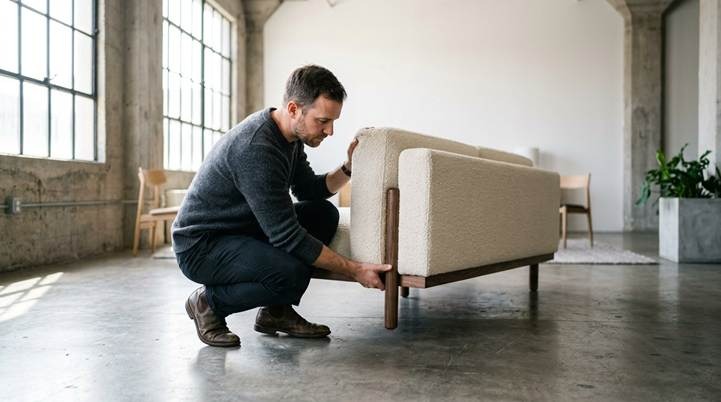
❝ When you’re in a showroom, don’t just sit on a sofa, lift a corner of it. A solid, kiln-dried hardwood frame is surprisingly heavy. If it feels light for its size, it is likely made with softer woods or engineered materials like particleboard.
The method used to join the frame together is just as important. Look for traditional joinery techniques that create strong, lasting bonds.
| Joinery Method | Description | Typically Found In |
| Mortise-and-Tenon | A projection on one piece fits into a hole on another. | Heirloom-quality wood furniture. |
| Dovetail | Interlocking trapezoidal pins and tails. | High-end drawers and case goods. |
| Dowels & Screws | Glued wooden pins or screws reinforce corner blocks. | Good quality, mid to high range. |
| Staples & Glue | Minimal connection, relies on adhesive for strength. | Mass-market, low-durability pieces. |
Next, ask about the upholstery and cushions. For fabrics, the key durability metric is the “double rub” count from a Wyzenbeek or Martindale test, which simulates the wear from someone sitting down and getting up. By common industry guidance, a fabric rated for 15,000 double rubs is considered suitable for heavy-duty residential use. For a family room sofa, seeking out fabrics rated at 30,000 or higher is a wise choice. For cushions, ask about the foam density, measured in pounds per cubic foot. A density of 1.8 is a good minimum, but high-resiliency (HR) foam with a density of 2.5 or higher will maintain its shape and support for much longer.
Finally, check the small details. On patterned fabrics, see if the lines and motifs match up across seams. This demonstrates meticulous craftsmanship. Open and close drawers to feel the glide mechanism; they should operate smoothly without sticking. These small indicators often reflect the overall care and quality invested in the entire piece.
What Should I Ask About Materials and Sourcing?
You should ask for the specific species of wood, the grade and tanning process of the leather, and the fiber content of the fabric. A material’s origin and processing details are the best predictors of how it will look and perform in your home over time, especially in a climate with low humidity like Denver’s.
For wood furniture, go beyond the simple “solid wood” versus “veneer” distinction. Both can be features of exceptional quality. When dealing with solid wood, ask for the species. Woods like walnut, oak, and cherry have different hardness levels and grain patterns. Critically, ask if the wood was kiln-dried. In Denver’s dry, high-altitude environment, improperly cured wood is prone to shrinking, cracking, and warping as it loses moisture. Kiln-drying stabilizes the wood to prevent this. For veneered pieces, ask about the substrate (the core material) and the thickness of the veneer. High-quality veneers are applied over a stable core like furniture-grade plywood or MDF to prevent warping, and a thicker cut allows for future refinishing. Look for signs of craftsmanship like “bookmatched” veneers, where two adjoining sheets are mirrored to create a symmetrical pattern.
When it comes to leather, the terminology can be confusing. The key is to understand the grade of the hide.
· Full-Grain: The highest quality grade. It comes from the top layer of the hide and includes all the natural grain and imperfections. It is incredibly durable and develops a beautiful patina over time.
· Top-Grain: The second-highest grade. The surface is sanded and a finish coat is applied, making it more resistant to stains but less breathable than full-grain.
· Corrected-Grain / Genuine: This is leather that has had an artificial grain applied to its surface and is heavily processed. It lacks the durability and unique character of the higher grades.
❝ Ask the salesperson, “Is this a full-aniline or semi-aniline leather?” Aniline is a transparent dye that showcases the hide’s natural surface, while semi-aniline has a thin protective topcoat for better stain resistance. An expert should be able to clearly explain the trade-offs in feel, durability, and maintenance for your specific needs.
Finally, for textiles, look beyond just the color and pattern. Ask about the fiber content and its suitability for your lifestyle. Natural fibers like linen and wool offer a luxurious feel, but performance fabrics, often made from synthetics, provide superior stain resistance and durability for high-traffic areas. Reputable sources should also be transparent about where their materials come from, often highlighting sustainable practices or certifications from bodies like the Forest Stewardship Council for their wood products. A store’s willingness to educate you on these details is a strong signal of their commitment to quality.
Frequently Asked Questions
What defines a “high-end” furniture brand? A high-end brand is defined by three core elements: original design, superior materials, and verifiable craftsmanship. These brands invest in renowned or emerging designers to create unique forms, rather than copying popular trends. They use top-tier materials like full-grain leathers and kiln-dried hardwoods, and their pieces are often bench-made, meaning a single artisan or small team builds the item from start to finish.
What separates a good furniture store from a great one? A good store has a nice selection of products. A great store provides a comprehensive service layer built on deep expertise. This includes professional interior design guidance, detailed product knowledge, transparent communication about sourcing and lead times, and meticulous “white glove” delivery and installation. They act as a long-term resource for your home, not just a transactional vendor.
Is custom furniture worth the extra cost and wait time? Custom furniture is worth it when you have a specific need that off-the-shelf pieces cannot meet. This could be an unusual room dimension, a desire for a unique fabric and finish combination, or the goal of creating a truly one-of-a-kind heirloom. While it requires a larger initial investment and more patience, the result is a piece that is perfectly tailored to your space and personal style.
How long should I expect to wait for high-end furniture? Lead times vary significantly based on origin and customization. In-stock items from a showroom floor can often be delivered within a week. For custom orders, pieces made in North America typically have a lead time of 8 to 16 weeks. For furniture crafted in Europe, you should plan for 16 to 24 weeks or more to account for production and transatlantic shipping.
Is American-made furniture always better quality? Not necessarily, but the U.S. has a strong heritage of high-quality furniture manufacturing, particularly in regions like North Carolina. At the same time, some of the world’s finest craftsmanship comes from international workshops, such as Italian leather specialists or Scandinavian woodworkers. The focus should be on the reputation and standards of the specific maker, not just the country of origin.
The Shift from Furnishing a Room to Building a Home
Ultimately, selecting furniture is about choosing which objects will share your life. The process moves beyond comparing prices and styles when you learn to see the underlying quality. By understanding the difference between a stapled particleboard frame and one with mortise-and-tenon joinery, or between corrected-grain leather and full-aniline hides, you change your role from a consumer to an informed investor in your own environment. This knowledge is the tool that lets you cut through marketing claims and identify true, lasting value.
The fundamental choice is not between one sofa and another, but between temporary decoration and permanent assets. Furnishings built with integrity become part of the home itself, gaining character over decades rather than breaking down after a few years. The goal is to acquire pieces that will not need replacing, making the initial investment the final one. Approaching the process with this mindset ensures the environment you create is not only beautiful but is built on a foundation of enduring quality.
About the author
The design team at Element Home contributes this piece. Based in Denver’s Cherry Creek North neighborhood since 2003, the company offers contemporary furniture, fine art, and professional interior design services. Their showroom features a curated collection of pieces from American, European, and Canadian makers, representing a commitment to original design and quality craftsmanship. The team works with clients to source specific pieces and develop comprehensive design plans for residential and commercial spaces, including white glove delivery and installation.