
Employee benefits become more complex when an employer desires more than a simple medical plan. Health care needs to be aligned with dental, vision, life, disability, retirement, employee communication and renewals, etc. all on a set budget.
That is where an independent broker can earn its keep.
Taylor Benefits Insurance takes an employer-centric approach when building group employee benefits packages, rather than selling you one big prebuilt bundle. Taylor’s biggest strength is their plan breadth, carrier comparison and hands-on guidance for businesses that want a broker to coordinate the moving parts.
For employers that value customization over self-service simplicity, the model is compelling.
Taylor Benefits Insurance
4.5 / 5
Verdict: Ideal for employers looking for a consultative broker to design, benchmark and assist with administration of a wide reaching benefits package based around employee needs and budget.
| Area | Score |
| Coverage breadth | 4.7 |
| Customization | 4.7 |
| Broker expertise | 4.6 |
| Commercial transparency | 4.0 |
Scores reflect the editorial assessment of the documentation, public evidence, commercial model and delivery examples.
In This Review
- Is Taylor Benefits Worth Considering?
- How Broad Is the Benefits Offering?
- What Does the Broker Model Add?
- What Does the Case Study Actually Prove?
- What Are the Pros and Cons?
- Who Is It Best For?
- Final Verdict
Is Taylor Benefits Worth Considering?
Yes, particularly for employers whose benefits program has outgrown a simple one-plan decision.
Taylor Benefits claims to have been in business since 1987. The company presents itself as an independent insurance brokerage specializing in employee benefit plans. The services listed on their printed materials include health, dental, vision, life, disability, voluntary benefits and 401(k) plans. They also mention conducting annual market reviews and providing continuous plan administration.
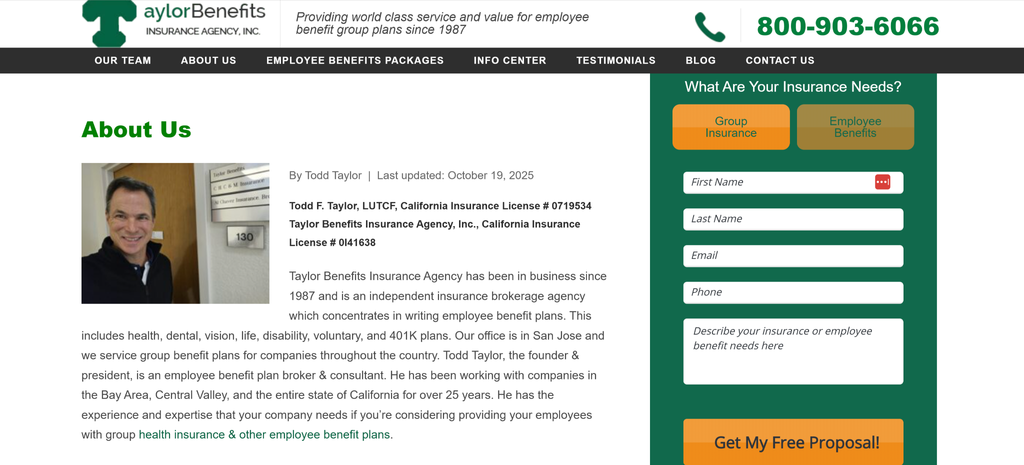
The company lists California insurance license numbers for founder Todd Taylor as well as the agency. Employers conducting their own background checks can verify insurance licenses through the California Department of Insurance license-status inquiry, which is the official method of looking up an agent or business entities license status/disciplinary history.
Here’s the value proposition in plain English: Taylor Benefits doesn’t want to be a company’s data-entry clerk. It aims to be the employer’s benefits adviser and coordinator.
How Broad Is the Benefits Offering?
Breadth is one of the clearest strengths.
The group employee benefits page covers a wide mix of plan categories, including:
- Core health coverage: group medical plans and related health options
- Dental and vision: separate supplemental coverage categories
- Income protection: short-term and long-term disability insurance
- Financial benefits: retirement, pension and 401(k) options
- Tax-advantaged accounts: HSA and Section 125 cafeteria plan options
- Additional protection: life insurance and long-term care coverage
That spectrum is important because benefits decisions are often made concurrently. An expanding employer could be facing medical costs, retirement participation and communications all together.
Taylor Benefits is strongest when the brief is a package, not a single product.
The company also notes that recommendations can be tailored based on workforce requirements and budget. That positions the service as a tool for employers who want to weigh beefed-up benefits against a set compensation budget.
What Does the Broker Model Add?
The broker model mainly adds comparison and coordination.
As HealthCare.gov puts it, enrolled small-business agents and brokers can assist employers in comparing plans, reviewing features, enrolling, completing renewals and managing changes to the plan. That expanded agent and broker role in small-business coverage is the context that makes Taylor Benefits’ model the most clear: The employer is paying for help navigating the decision-making process, not simply access to the policy itself.
Taylor Benefits says it analyzes current coverage, shops competitive carrier options and revisits client plans at renewal. Its administrative material also mentions helping with enrollments, eligibility changes, employee inquiries, carrier coordination and compliance changes.
Why does that matter?
Outsourcing support doesn’t absolve the employer of responsibility. See the U.S. Department of Labor’s guidance on fiduciary responsibilities under group health plans. Employers and plan fiduciaries retain specific responsibilities even when outside service providers perform daily functions.
Automating benefits with a good broker can lighten your administrative burden. However, it does not eliminate the need for benefits governance.
What Does the Case Study Actually Prove?
The supplied case study is useful, with one important qualification.
In Taylor Benefits’ recently published Texas SaaS case study, a company with 35 employees transitioned from a fully insured PPO product to a level-funded plan with a dual-design. Monthly premiums decreased from $28,000 to $19,600, representing a 30% savings.
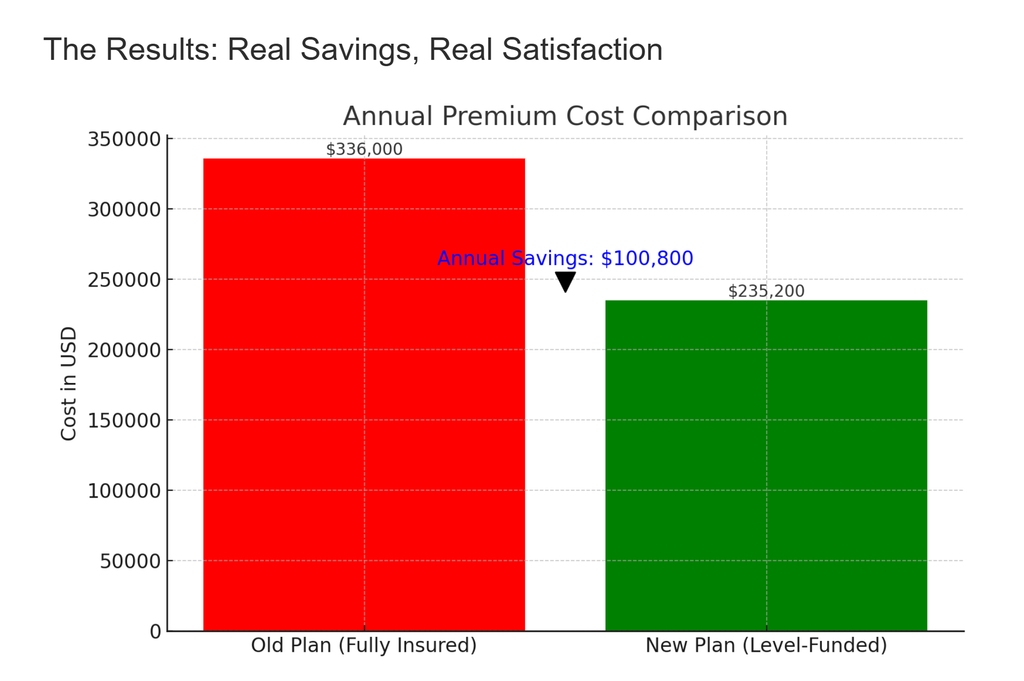
Process is just important as outcome. This wasn’t just the same plan repriced by another carrier. The reported savings were achieved through a shift in funding model, plan design and employee choices.
While this case study does show Taylor Benefits’ capacity to redesign a benefits strategy, do not read this as a guarantee that another employer will save exactly the same amount.
Exactly. That’s how you should think about the proof point: as proof of what the brokerage is capable of doing, not as an across-the-board savings prediction.
What Are the Pros and Cons?
What works
- Tailor-made package design: service built around workforce needs and budget, not a predetermined bundle.
- Wide-ranging benefits menu: health, dental, vision, life, disability, retirement and more can all be bundled together.
- Independent-broker approach: the company brokers deals as if it has multiple carrier options when it only uses one insurer.
- Continued employer support: renewal, enrollment assistance and admin support continue the relationship past placement.
What doesn’t
- No immediate public quote: Prospective employers must speak with a representative to get a customized price. Not as buyer-friendly if you just want to know how much something costs without talking to a salesperson.
- Uses partner providers for some administration: Taylor Benefits notes COBRA administration and some elements of FMLA or HR-system administration are performed by third parties. This is most relevant for employers who desire single platform administration for every function.
Who Is It Best For?
Taylor Benefits best fits small and mid-sized employers as well as larger employers who desire a high-touch broker partnership.
Especially helpful for businesses that need multiple benefits categories managed simultaneously, plan to switch carriers at renewal, or simply don’t want an internal HR team managing every enrollment or vendor inquiry by themselves.
A direct carrier may be the easier route if you know exactly what policy you want as the employer. You may want to consider a PEO if you want to package payroll, HR and benefits into a larger outsourced employment solution.
Taylor Benefits fills that gap in the middle: more consultative than buying direct, less benefits focused than turning over your entire HR function to a PEO.
Final Verdict
Taylor Benefits Insurance is a legitimate choice for employers seeking flexibility with plan options and access as well as a broker that doesn’t walk away after you make your selection.
Its greatest asset is the form of the service. The employer has the ability to come with a blended benefits package and address medical insurance, supplemental benefits, retirement options, carrier comparisons and administrative support all as part of one seamless issue.
The downside is also obvious. Pricing is negotiated, not instantly transparent. Some admin services rely on partner providers.
If employers are okay with that service provider model then those are parameters, not deal breakers.
Taylor Benefits Insurance is ideal for companies seeking a tailored employee benefits plan with continued broker support, rather than a “click-to-buy” insurance product.