However, as companies implement cloud-based applications, telecommuting and distributed networks, traditional security models might become challenging. Applications and users might operate from different locations, which implies the requirement for greater flexibility within the context of centralized security.
A well-planned approach to implementing the right SASE solution can help organizations bring networking and security capabilities together through a cloud-based approach. SASE implementation, however, involves more than merely the introduction of new technology. It is important for businesses to assess their infrastructure, security needs, end-users, applications, and objectives before choosing whether or not to implement SASE.
Secure Access Service Edge is especially valuable for enterprises dealing with intricate cloud and hybrid scenarios. Taking into account the necessary elements prior to deployment will ensure minimal disruption, better security management, and development of an architecture capable of evolving alongside their business processes.
What Is a SASE Solution?
Secure Access Service Edge (SASE) is a cloud-based security platform which integrates networking and security features to provide users, applications, and resources protection from any location.
Instead of having security controls purely inside a corporate network, SASE allows bringing security much closer to the user and to the resource used by the user. Based on the solution type, such features as secure web gateway, Zero Trust Network Access, Firewall as a Service, cloud access security, and software-defined networking are provided.
Why Businesses Are Considering SASE
With the increasing reliance on cloud computing and working remotely, accessing company resources has become more complicated for users. Connections can be done from different locations and devices, and the software and data can be located on various cloud computing solutions. SASE may assist businesses in coping with such situations.
There are some reasons for adopting SASE:
- More work from home/hybrid work
- Increased usage of cloud-based apps
- More than one office/branch office
- Dispersed business assets
- Complicated security management
- Requirement of uniform access policies
Important Factors that Need to Be Considered for SASE Implementation
The SASE implementation process must start with having an understanding of the environment within which the business is operating currently.
1. Assess Current Network Infrastructure
A firm needs to evaluate its current network infrastructure including any on-premises infrastructure, cloud resources, branch offices, remote users, and security measures in place. The analysis will help to find out the limitations in the current infrastructure and what SASE capabilities the firm will need.
2. Determine Security Needs
The firm needs to determine what security challenges it would like SASE to solve. It may be remote access security, web security, application security, data security or policy consistency.
Defining these needs will help to analyze available options for the firm and eliminate unnecessary capabilities.
3. Determine Cloud and Remote Access Requirements
SASE is a technology aimed at managing distributed networks, so for companies with remote employees and cloud applications it will be especially useful.
The firm needs to evaluate how employees access applications now and if there are sufficient security controls in place for such access.
4. Find Out Compatibility With Existing Security Technologies
Implementing SASE will not necessarily mean replacing all existing security technologies. The firm needs to determine how new SASE capability will integrate with identity management, endpoint security, firewalls, monitoring systems and others.
5. Consider Scalability
A SASE implementation needs to cater to both the present as well as future business requirements. The organization should anticipate the possible increase in users, applications, cloud services, geographical locations, and network traffic.
Selecting an architecture that is scalable can help the business in avoiding major changes in their infrastructure as the environment grows in size.
6. Assess Management Requirements
Implementation of a SASE architecture will shift the responsibility of policy management and network access from the traditional way to a more modern cloud-based way. Business organizations need to assess whether they possess the necessary skill set and resources for managing the solution.
7. Assess the Compliance Requirements
Business organizations working in regulated environments should consider whether the selected SASE solution helps them in meeting their security and compliance needs.
Access control, monitoring, logging, policy management, and data protection capabilities in a solution can assist businesses in ensuring security and compliance.
8. Plan a Gradual Deployment Strategy
There is no need for all businesses to deploy SASE immediately to their whole organization. This can be done using a phased implementation to test the implementation on chosen users, applications, and/or locations.
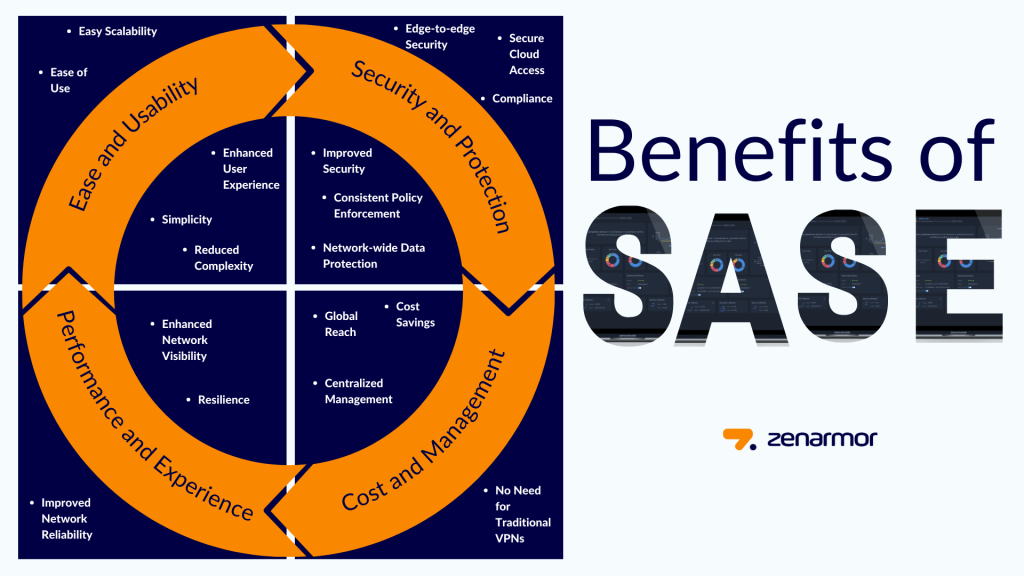
Advantages of a Strategically Designed SASE Implementation
Apart from the security benefits, a strategically designed SASE implementation offers various other advantages to organizations including simplifying security operations in the current business environment.
- Security Management Through Centralization: Coordinate all security functionalities in an improved manner.
- Enhanced Visibility: Acquire more visibility into the users, applications, devices, and network traffic.
- Secure Remote Connectivity: Ensure secure connectivity of the users to the business resources.
- Unified Security Policies: Implement security policies across various distributed environments.
- Improved Scalability: Accommodate any changes in the users, applications, locations, and cloud environments.
- Operational Simplification: Minimize the complications of managing the separate networking and security technologies.
Common Problems Encountered During the Implementation of SASE
SASE implementation may be problematic to some extent, particularly for companies that have intricate or obsolete IT infrastructure.
| Challenge | What It Means |
| Integration With Existing Technologies | It is important to properly plan how to tie SASE in with existing security and networking solutions. |
| Migration Complexity | The transition from existing network architecture to SASE can bring about considerable changes in existing processes. |
| Limited Expertise | The internal teams might need more training and knowledge to implement SASE successfully. |
| Access Policy Management | Developing suitable access policies for varied individuals, systems, and software can be difficult. |
| Multi-Cloud Management | Consistency of security in different cloud platforms may lead to complexities. |
| Migration Disruption | Badly planned migrations may impact users, applications, or even daily operations. |
| Process Changes | The security and network management procedures in place may need updating due to the new architecture. |
Best Practices for the Implementation of Secure Access Service Edge (SASE)
Organizations are advised to take SASE into consideration as an ongoing security and networking approach, not a one-off implementation of technology. Prior to implementing SASE, there needs to be an established goal and prioritization of the environment’s components.
- Evaluate the current network and security infrastructure.
- Determine specific business and security requirements.
- Prioritize key users and applications.
- Deploy SASE with current security products when necessary.
- Test policies prior to scaling deployment.
- Educate IT and security personnel.
- Monitor performance and security consistently.
- Evaluate and update policies as needed.
An implementation approach based on structure can assist organizations to reap the advantages of SASE while avoiding complexity.
Final Thoughts
SASE may be used to give companies a scalable way to protect users, applications, and resources in cloud or distributed environments. But for a proper implementation of SASE, it is not enough just to choose a SASE architecture. Businesses need to analyze their existing infrastructure, their security requirements, their integration needs, scalability, compliance, and operations. In this case, SASE will help businesses implement it while building a security architecture that will support remote working, cloud and future growth of the company.
Frequently Asked Questions
1. What should businesses consider before implementing SASE?
The business must consider its network infrastructure, security needs, remote access needs, security products, scalability, compliance issues, and internal capabilities.
2. Does SASE replace traditional firewalls?
Certainly not. SASE is capable of integrating Firewall as a Service, but traditional firewalls can still have their uses in securing certain networks and workload infrastructures based on organizational needs.
3. Should businesses implement SASE all at once?
It makes more sense to implement an approach on a phased basis. Companies may begin with some chosen users, applications, or places, then analyze the outcome, and proceed further accordingly.
4. What are the main benefits of SASE?
SASE offers such features as centralized security management, enhanced visibility, secure remote access, consistency in policies, increased scalability, and streamlined network and security operations.