When selecting soda feldspar, it is not just about the supplier with the lowest price per tonne. When you make ceramic tiles or sanitaryware and tableware, glass or similar items, the mineral composition can influence firing behavior, vitrification, finish and the general consistency of production.
Soda feldspar is mainly used in ceramic production as a flux, which helps consolidate the raw materials during firing. Its structure and uniformity thus becomes important in every production batch. You must go beyond quotations and consider quality control, technical requirements, processing capacity, consistency, reliability of supply and knowledge of application before you shortlist soda feldspar manufacturers.
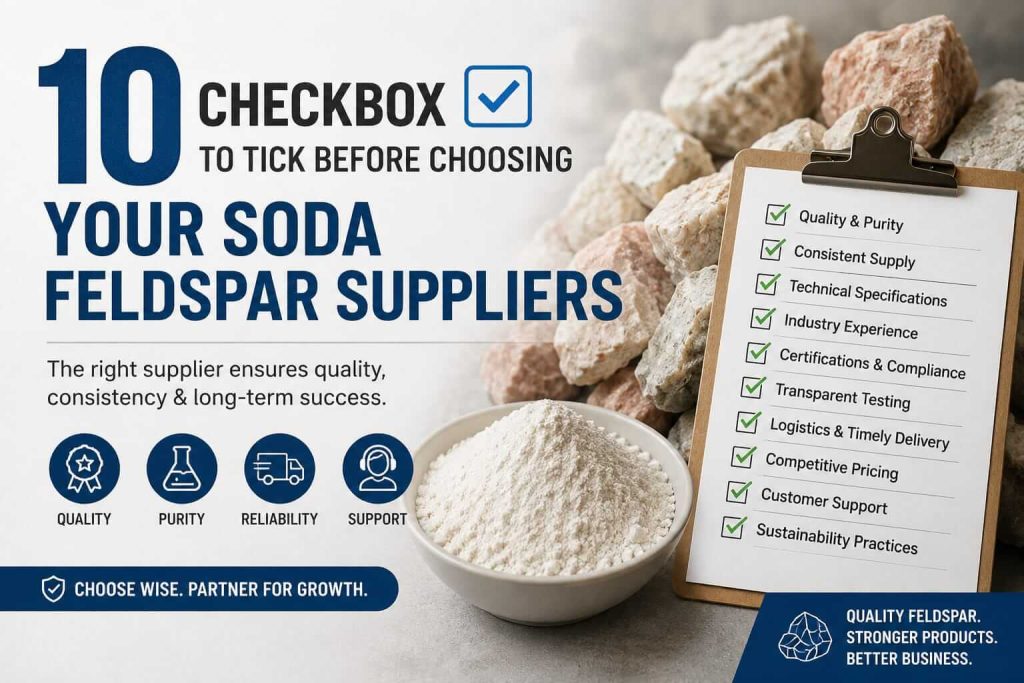
The following are 10 boxes that you should tick before making your decision:
Why Choosing the Right Soda Feldspar Supplier Matters
Your supplier is involved in your production process. The chemistry of feldspar may affect how a ceramic body or glaze performs during firing, and nonconforming raw material may force unwanted formulation or process changes.
A trustworthy supplier must provide more than feldspar. You need consistent material that is predictable, compatible with your application, and reasonably consistent across repeat orders.
10 Checkboxes Before Selecting a Soda Feldspar Supplier
Raw-material characteristics are different in various ceramic formulations. Rather than believing that all your soda feldspar grades are identical, compare suppliers to the needs of your real production process.
1. Check the Chemical Composition
Start with the material’s chemical analysis. Compare your formulation requirements with such important constituents as Na2O, SiO2, Al2O3, K2O and Fe2O3. Indian Bureau of Mines observes that the specifications depend on the use of ceramics, and thus application specific chemistry is important rather than purchasing a material labeled as soda feldspar.
2. Verify Batch-to-Batch Consistency
A single sample gives you no idea about the next ten shipments. Inquire on how the supplier manages inter-batch variation. Stable chemistry and physical characteristics assist you to retain consistent formulations, firing behavior, and end product quality without having to keep varying production parameters.
3. Look at Iron Content
Colour Iron has the ability to affect fired colour and appearance, so Fe2O3 is very significant in applications where whiteness or color fidelity is a concern. Do not measure iron levels alone, though. Establish reasonable boundaries that are related to your ceramic body, glaze and final product needs.
4. Check Particle Size and Fineness
If you are buying processed feldspar powder, consistency in particle size is important. The differences in fineness may influence the mixing, dispersion and processing behavior. Ask your supplier whether they can meet the mesh or particle-size specifications you need for your production line, rather than providing a generic grade.
5. Ask About Quality Testing
Do not be fully dependent on a promise that the mineral is of a good quality. Inquire about testing incoming material and finished batches. Suppliers with laboratory facilities can check key physical and chemical properties before delivering materials to your factory.
6. Evaluate the Raw Material Source
The mineral composition of feldspar depends upon the deposit feldspar grows out of. Knowing that your supplier has reliable access to its raw-material sources can also inform you more about long-term consistency and continuity of supply. Direct access to mining can offer more control with the help of appropriate testing and processing.
7. Match the Grade to Your Application
A ceramic body with soda feldspar might not require the same properties as a glaze or another industrial application. Tell your supplier what you are producing, and ask whether they can suggest a grade based on your needs.
8. Check Supply Capacity
Quality is useless if your production line constantly waits for raw material. Talk about monthly needs, order quantities, lead times and repeat demand capability of the supplier. As your business scales, ensure your supply capacity can scale with it.
9. Review Packaging and Logistics
When feldspar leaves the processing facility, procurement of raw materials is not over. Logistics must support predictable delivery, so packaging must fit your handling and storage needs. Confirm quantities, packaging style, delivery schedules, and transportation options before placing standard orders.
10. Test Before Long-Term Procurement
When choosing a supplier, never pick one based only on a spec sheet. Ask for a representative sample and proceed to test it in your actual production conditions. Test the material’s performance in your body or glaze formula and firing cycle before moving to larger or repeat orders.
What Should You Ask a Soda Feldspar Supplier?
Maintain your procurement discussion practical before sealing your supplier. Ask:
- Can you provide a current chemical analysis?
- How do you maintain batch consistency?
- What grades are available for my application?
- What particle sizes can you supply?
- How is the material tested?
- What quantities can you supply consistently?
- Can I test a sample before placing a bulk order?
These questions are answered clearly and tell you much more than mere low quotations.
Conclusion
The right soda feldspar supplier must help you maintain production consistency, rather than introduce another variable your technical team must control. Before you commit, chemistry, testing, raw-material control, application suitability, processing and reliable supply all merit much attention.
Expolica Ceramics integrates resource-intensive mining with lab testing, research and development, mineral processing, and quality control, with a focus on applications, to provide manufacturers with reliable ceramic raw materials. Its products include Soda Feldspar, along with Ball Clay, Kaolin Clay, Potash Feldspar, Quartz, and other minerals used in ceramic production.
When deciding on your next soda feldspar requirement, don’t choose based on price alone. Contact Expolica Ceramics to discuss your application, required specifications, and supply needs, and we’ll recommend the appropriate grade of soda feldspar for your production.
FAQs
1. What do you need to look into before purchasing soda feldspar?
Before engaging in regular procurement, you should consider chemical composition, iron content, particle size, batch consistency, testing methods, application suitability, capacity to supply and logistics.
2. What is the purpose of using soda feldspar in ceramics?
Soda feldspar is a flux used in firing ceramics. It aids in the melting and vitrification and adds to the processing and final qualities of the ceramic bodies and glazes.
3. What is the importance of batch consistency in soda feldspar?
Batch differences can alter your formulation’s behavior during processing and firing. Stable raw material assists producers to have a more predictable level of production and quality of the finished product.
4. Will you test soda feldspar prior to bulk purchasing?
Yes. A specification sheet is a handy piece of information, however testing in production reveals the way the material will act out in your particular formulation, firing cycle and manufacturing process.