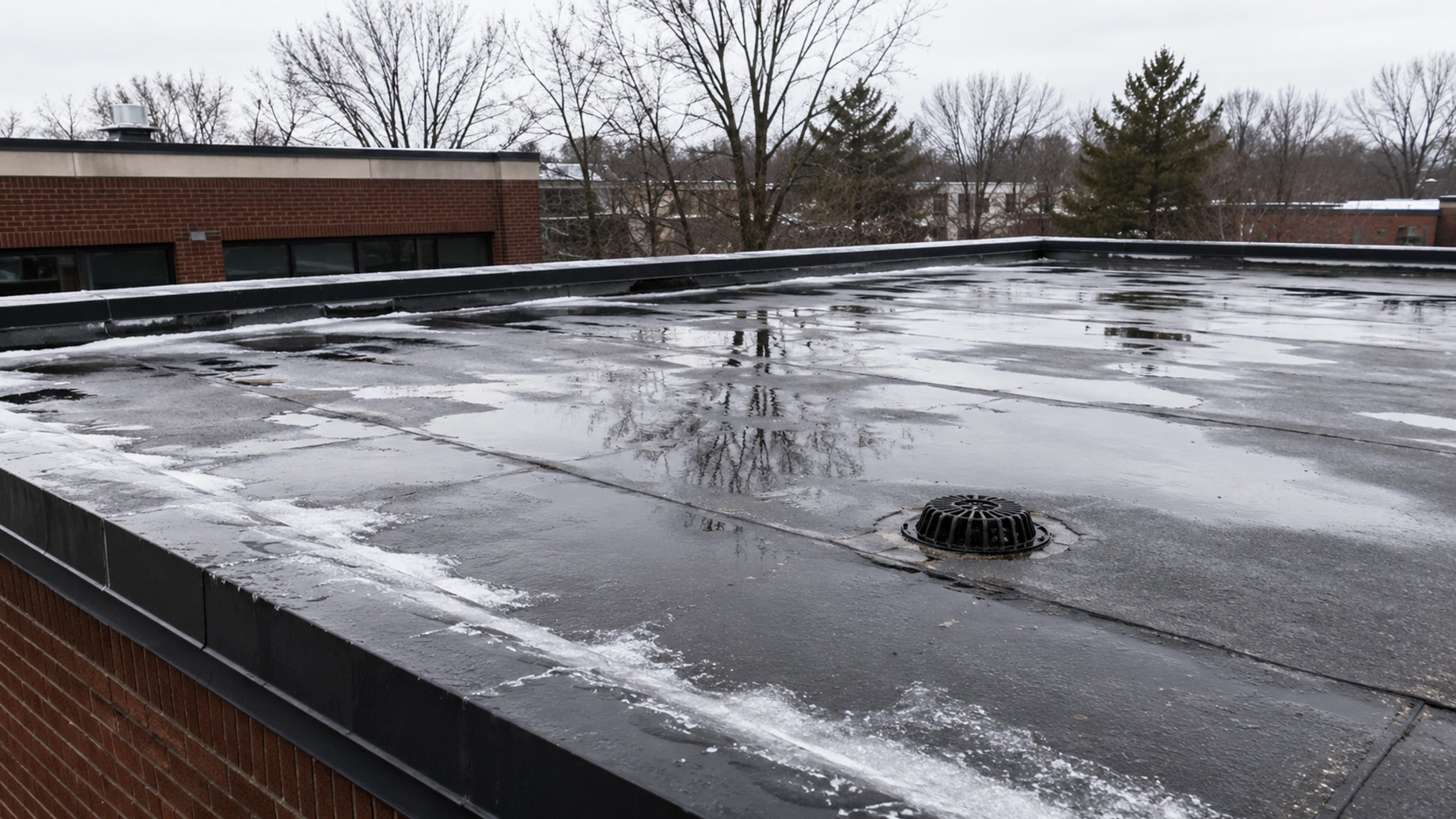
Princeton’s commercial landscape blends historic buildings near the university with modern office complexes and retail centers, and nearly all of them share a common roofing challenge: flat or low-slope roof systems that face New Jersey’s specific combination of freeze-thaw cycling and heavy seasonal rainfall. Understanding how these two factors interact explains why so many commercial roof failures here trace back to the same underlying causes.
Why Ponding Water Is the First Problem to Understand
Ponding water, defined in the industry as water remaining on a roof surface for 48 hours or more after rainfall, is one of the most destructive conditions a flat commercial roof can experience. New Jersey’s spring and summer storms often arrive in intense bursts that test drainage systems, and flat roof designs, while cost-effective and practical for large commercial buildings, inherently create more opportunity for water to collect than a pitched residential roof would. When drainage can’t keep pace with rainfall intensity, water accumulates rather than draining away, and that standing water accelerates membrane degradation right where it sits.
Why Winter Freeze-Thaw Compounds the Ponding Problem
Here’s where Princeton’s climate adds a second layer of stress on top of ponding. New Jersey winters bring real freeze-thaw cycling: daytime temperatures above freezing melt accumulated snow and ice, sending that water into every crack, seam, and roof penetration it can find. When temperatures drop again overnight, that water freezes and expands, forcing existing openings wider and creating new pathways for water intrusion that didn’t exist before the freeze.
Ice dams form through a related mechanism: heat escaping through the roof melts snow, which then refreezes at the roof’s edge where temperatures run colder, creating a dam that traps water behind it. This combination, standing water from inadequate drainage plus the expanding force of repeated freezing, is why so many flat commercial roof failures in this climate trace back to the same root causes rather than a single dramatic storm event.
Why Princeton’s Historic Buildings Add Another Layer of Consideration
Princeton’s numerous historic properties, including buildings near the university itself, require specialized knowledge that goes beyond standard commercial roofing practice. These buildings often need to balance authentic preservation requirements with genuinely modern waterproofing performance, which isn’t always straightforward when a historic building’s roofline or structural details weren’t designed with contemporary drainage standards in mind. A contractor unfamiliar with institutional and historic preservation guidelines can end up specifying a technically sound roofing system that still runs into approval or compliance issues for these specific properties.
What Membrane Choice Actually Means for This Climate
Given the combination of ponding risk and freeze-thaw cycling, membrane selection matters considerably:
- EPDM rubber membrane offers genuine flexibility and durability through repeated freeze-thaw cycles, since the rubber composition expands and contracts without the brittleness that affects more rigid materials, making it a reasonable fit for New Jersey’s winter conditions specifically
- TPO membrane provides strong heat reflectivity, which helps reduce cooling costs during the state’s hot, humid summers, along with solid puncture resistance
- Standing seam metal roofing, where the building’s structure allows it, performs measurably better under freeze-thaw cycling specifically because its concealed fastener system accommodates thermal expansion without the fastener pullout that exposed-fastener systems can experience over repeated cycles
- Proper drainage design, including adequately sized and positioned drains and scuppers, matters as much as membrane choice, since even the best membrane degrades faster if water is allowed to pond against it regularly
Why Regular Inspection Matters for Flat Commercial Roofs Here
Because both ponding water and freeze-thaw damage develop gradually rather than announcing themselves through a single dramatic failure, regular inspection, particularly checking drainage function before winter and after any significant storm, catches problems while they’re still manageable repairs rather than full membrane failures.
Getting a Roofing Plan Built for Princeton’s Specific Conditions
Because this combination of ponding risk, freeze-thaw stress, and, in many cases, historic building considerations is genuinely more complex than standard commercial roofing in a milder or more uniform climate, working with a Princeton NJ commercial roofing company that understands all three factors together is worth prioritizing over a generic regional bid that doesn’t account for what Princeton’s buildings and climate actually demand.
