International buyers arriving at Logan International Airport begin the trip with clear priorities: complete passport control, retrieve luggage, and secure immediate transport. Passengers disembarking at Terminal E follow the international arrival signs toward passport control and customs, where processing times depend on flight volume and Global Entry status. Allow at least 45–90 minutes from gate to exit for standard arrivals; plan longer during peak evening windows or convention periods.
After clearing immigration, follow baggage claim signage, note carousel numbers on airport monitors, and prepare for mobility needs such as luggage carts, porter services, or a meet-and-greet chauffeur stationed at the arrivals hall.
Terminal E Arrival Experience — What International Buyers Should Expect
Terminal E offers organized arrival facilities created for international travelers. Passport control and U.S. Customs hold centralized lines; Global Entry reduces wait time substantially and regularly routes travelers to a faster kiosk area. Currency exchange counters and ATM machines sit near the arrivals corridor, enabling quick access to local cash, while major mobile providers and airport kiosks provide eSIM activation or local SIM cards for immediate connectivity.
Several lounges and premium waiting areas operate inside Terminal E; international property buyers can arrange lounge access through memberships or one-time passes for a brief rest before meetings. Luggage trolleys remain available near baggage claim, and airport porters offer paid assistance for heavy or multiple bags. Family groups or teams usually regroup near marked meeting points in the public arrivals level, where drivers display name boards or digital confirmations to expedite handoffs.
Choose the Right Airport Transportation Service
Smart planning starts days before departure. Because international itineraries often route through a connection at Newark Liberty International Airport, pickup details must account for shifting arrival times. A good airport pickup service confirms the flight, terminal, and bag count ahead of the date.
A few things worth confirming when you book car service to Logan Airport for an arrival:
- The exact terminal and whether the flight is international, since Terminal E and Terminal C use different meeting points.
- The number of suitcases, which decides whether a sedan, a luxury SUV transportation option, or a larger van fits the group.
- Any planned stops, such as a check-in at the Four Seasons Hotel Boston before an afternoon showing.
- A backup contact method in case a roaming plan is not active on landing.
For a multi-day trip, Boston car service providers like Blue Nile Livery can hold a vehicle all day, making back-to-back viewings across Back Bay and the Seaport easier. Blue Nile Livery and similar firms often work with buyers’ agents so the driving schedule lines up with appointments.
Executive Transportation Expectations — Vehicles, Chauffeurs, and Service Standards
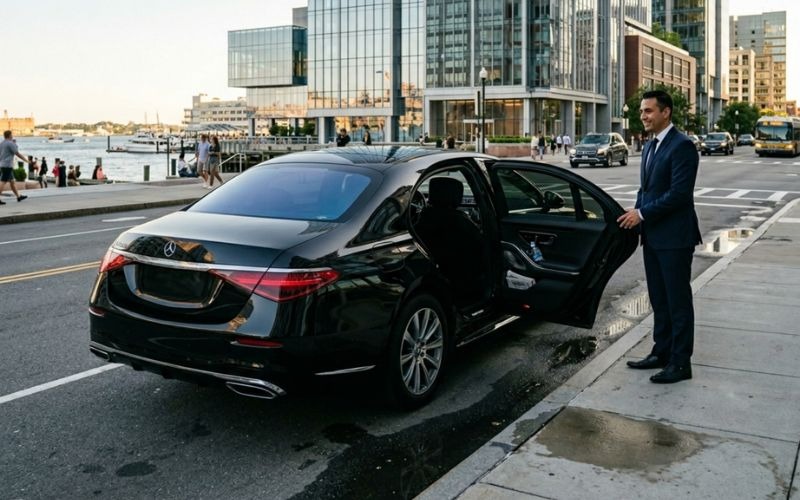
Executive transportation in Boston typically includes luxury sedans, large SUVs, and vans that match group size and luggage needs. Common vehicle models include Mercedes-Benz S-Class for solo executives, Cadillac Escalade and Lincoln Navigator for groups with substantial luggage, and Mercedes-Benz Sprinter vans for teams or equipment-heavy transfers. Chauffeurs present polished uniforms, valid commercial licenses, and local route knowledge; expect chauffeurs to provide meet-and-greet signage, monitored flight arrival updates, and assistance with loading luggage.
Verify credentials such as commercial insurance, company references, and a clear cancellation policy before booking. Confirm vehicle amenities like climate control, Wi-Fi, bottled water, privacy partitions, and secure document storage to support high-net-worth expectations and maintain confidentiality during transits between Logan and viewing sites.
From Airport to Seaport — Route Choices and Typical Transit Times
Driving routes from Terminal E to the Seaport District vary by time of day and final Seaport destination. Most direct transfers use the Ted Williams Tunnel to connect from Logan area roadways toward Interstate 90 and then follow Seaport Boulevard or Summer Street into Fan Pier and the core Seaport towers. Off-peak drives typically take 12–20 minutes in sedans; expect 20–35 minutes during morning and evening rush hours.
Large events near Fenway Park or conventions at the Boston Convention and Exhibition Center increase congestion on surface streets and the I-90 approaches, adding 15–30 minutes. For faster transit during peak congestion, chauffeurs may route via the Callahan and Sumner tunnels and then follow Seaport Boulevard for direct drop-offs. Predictive routing and local chauffeur experience reduce variability and keep property-viewing schedules reliable.
Planning Property Viewings — Timing, Transport, and Neighborhood Walkthroughs
Plan viewing itineraries with conservative travel buffers and grouped neighborhoods to maximize productive time. Schedule the first viewing at least two hours after scheduled touchdown when flights clear and luggage retrieval finishes; add 30–45 minutes when arriving during peak arrival windows. Arrange private car service or chauffeur bookings that allow multi-stop itineraries to view One Dalton, Millennium Tower, EchelonSeaport, and Pier 4 in a single day while minimizing wasted transfers. Prioritize Seaport sites early in the day to avoid afternoon traffic on Summer Street and Seaport Boulevard, then move toward Back Bay or Beacon Hill when traffic patterns improve.
Confirm parking or curbside drop-off permissions at each building, and ask agents to secure elevator access and short-term storage for property documents or samples. Walkability inside the Seaport remains strong near Fan Pier and Harborwalk; plan brief neighborhood walkthroughs on foot after vehicular drop-offs to assess local streets, waterfront views, and amenity proximity.
Chauffeur Advantages for Buyers — Privacy, Time Management and Local Insight
Hiring a professional chauffeur service delivers measurable benefits for buyers focused on efficiency and discretion. Chauffeurs maintain direct communication with agents and property managers to align arrival times and freshen routes in real time. Expect bilingual drivers on request who provide local neighborhood context, point out access routes to institutions such as Harvard or MIT, and suggest alternate drop-off points that save time. Professional services secure space for confidential documents and samples in lockable compartments and offer discreet loading zones near luxury tower entrances. Time management advantages appear in minimized walking between appointments, prioritized curbside access at high-end hotels such as Four Seasons Hotel Boston or InterContinental Boston, and prioritized routing around event-related congestion near TD Garden or BCEC.
Two Quick-Reference Checklists for Arrival-Day Needs
Immediate Arrival Priorities
- Carry passport, customs declaration forms, and property purchase paperwork in a single accessible folder.
- Verify Global Entry or visa documents before disembarkation; prepare photocopies and digital backups.
- Activate eSIM or local SIM at Terminal E kiosks to enable local calling and mobile confirmations.
- Exchange a modest amount of currency at the arrivals counter or use airport ATMs.
- Confirm chauffeur contact details and exact meeting point on the public arrivals level.
- Reserve a luggage trolley or porter service if arriving with bulky or numerous suitcases.
Transport and Viewing Arrangements
- Book private car service with flight monitoring and meet-and-greet capability for punctual pickups.
- Confirm vehicle capacity and trunk volume for all luggage and materials required for viewings.
- Allocate 30–45-minute buffers between consecutive viewings to accommodate traffic or building access.
- Provide the agent and chauffeur with a prioritized viewing list and building entry instructions.
- Request bilingual chauffeurs when language assistance or local introductions may assist negotiations.
- Establish return transport or short-term storage arrangements with the hotel or property manager for items collected during tours.
Seaport District Impressions — Where Luxury Residences Meet Waterfront Life
Seaport presents a modern waterfront environment that blends new residential towers with active public spaces and marina views. Tall glass facades at EchelonSeaport, Pier 4, and Fan Pier reflect Boston Harbor and frame ranked restaurants, boutique hotels, and green promenades along the Harborwalk. Residents find a compact urban rhythm that favors walkability between waterfront parks and local cafes while offering quick vehicle access to Back Bay and the Financial District via Summer Street and Seaport Boulevard.
Cultural venues and the BCEC maintain consistent foot traffic during large events, and luxury buildings deliver concierge services, fitness centers, and private amenity floors that appeal to buyers seeking turnkey waterfront living.
Investor and Relocation Considerations — Visits That Turn Into Moves
Frequent investors or relocating families should adopt recurring transport strategies and local service partnerships. Establish corporate transportation accounts to streamline repeated Logan transfers, secure preferred chauffeurs, and access negotiated hourly or multi-day rates. Consider temporary storage or short-term furnished rentals to ease the transition between visits, and coordinate movers with property managers before the first large shipment arrives.
Evaluate neighborhood proximity to institutions such as Harvard, MIT, or Northeastern University when schooling factors influence relocation. Confirm long-term parking options and public transit links from Seaport to Cambridge and downtown employment centers to plan daily commuting patterns after relocation.
Final Thoughts
For international buyers, the arrival sets the tone for everything after. A calm run from Terminal E to a Seaport address means the first impression of Boston is the city itself, not the friction of getting there. Booking private airport car service ahead of the flight, with a driver who knows the Ted Williams Tunnel at noon versus five o’clock, makes for an easier visit. Booking a Logan Airport car service does the quiet work while the buyer focuses on the homes. Blue Nile Livery is one of the firm’s international clients turn to, and many keep the same number for car service to Logan Airport on every trip back, from the gate to the day they pick up the keys in the Seaport District.