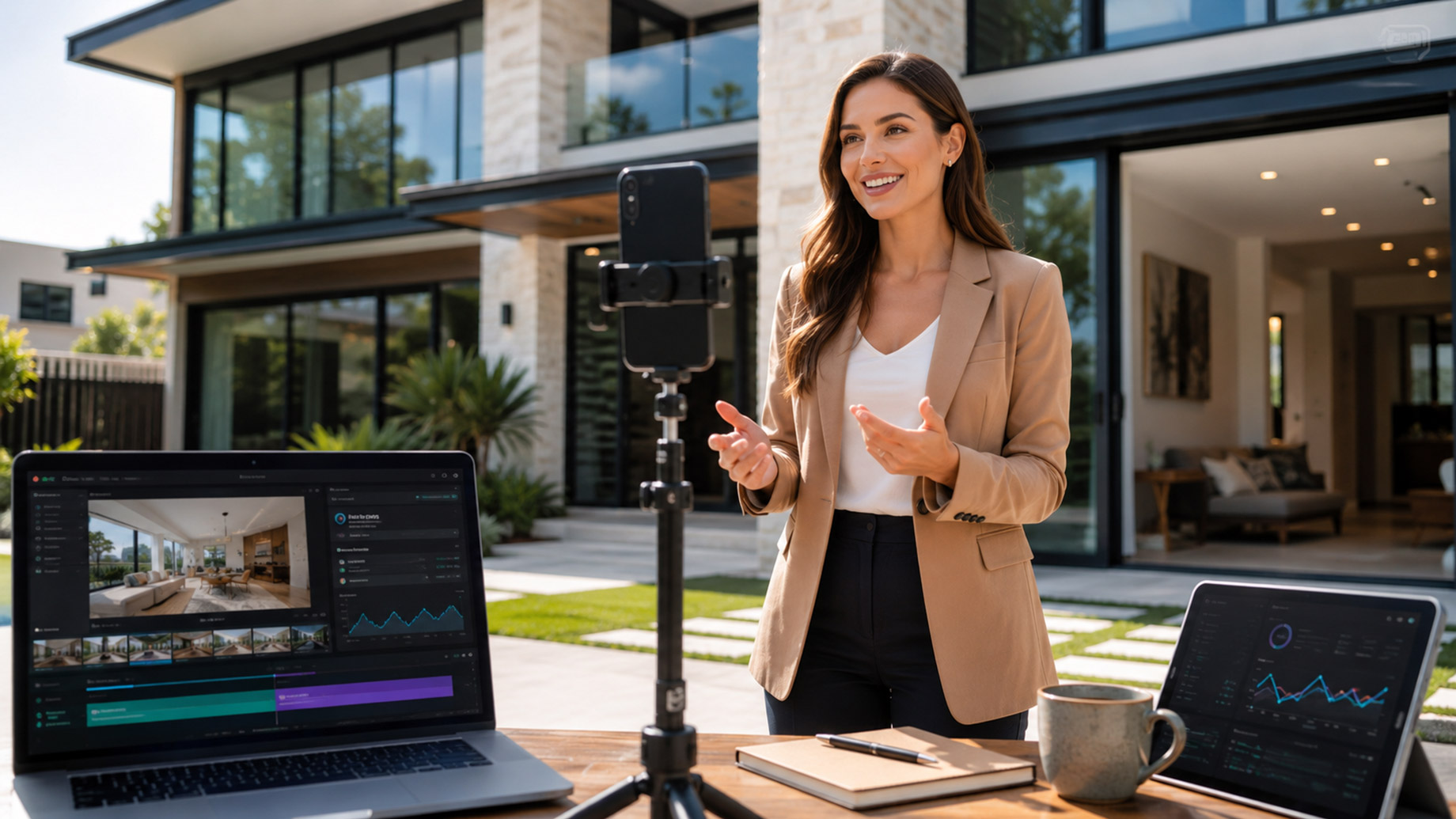
The way buyers discover properties has changed more in the past three years than in the previous decade. Search still matters. Referrals still matter. But for a growing segment of buyers — particularly younger, more digitally active ones — the first exposure to a property or an agent now happens on a short-form video platform.
An Instagram Reel showing the view from a penthouse terrace. A YouTube Short walking through a newly renovated townhouse. A TikTok neighborhood guide shot during an early evening walk through a tree-lined street. These aren’t polished productions from large agencies with marketing budgets. They’re coming from individual agents who have figured out that showing up consistently on video is one of the most effective ways to stay visible in a market where attention is the scarcest resource.
The obstacle for most agents has always been production. Filming is manageable. Editing, formatting, captioning, resizing for each platform, and publishing regularly — that workflow has traditionally required either a dedicated social media manager or hours of personal time that most agents simply don’t have.
AI video tools have made that workflow significantly more manageable for agents working on their own.
Why Video Has Become Essential in Real Estate Marketing
The case for real estate video is no longer about early adoption — it has become a baseline expectation. Listings that include video receive substantially more inquiry activity than those without. Properties shown through video tours generate higher levels of remote-buyer interest — particularly relevant in markets that attract relocation buyers or international investors. And for agents building a personal brand, short-form social video has become one of the few remaining channels where organic reach is still meaningfully available without paid amplification.
There’s also a trust dimension that matters in luxury real estate specifically. A buyer considering a significant purchase wants to feel that they know the agent before they make contact. A consistent video presence — market commentary, property highlights, neighborhood context — builds that familiarity over time in a way that a static website profile does not. For agents working the upper end of the market, that relationship capital is directly tied to lead quality.
The agents who have built the most effective video presences tend not to be the ones with the highest production values. They’re the ones who show up consistently. Consistency requires a workflow that’s sustainable — which is where the production bottleneck has historically broken down.
How Agents Without Production Teams Are Competing
For agents at large brokerages, some marketing infrastructure exists. For independent agents and small teams — which represent the majority of active practitioners — video content production has to happen within the hours that aren’t already committed to client work.
The category of tools addressing this gap is broadly called AI video marketing for real estate: platforms that automate the mechanical steps of production — assembly, pacing, captioning, and platform formatting — so the agent’s time is spent on the strategic and relational elements rather than the technical ones.
In practice, this means an agent can record a 10-minute property walkthrough, drop the footage into the tool, and receive a set of platform-ready clips — correctly formatted for Reels, Shorts, and feed video — in a fraction of the time it would have taken to build the same clips manually. The tool handles cut selection, identifies the strongest visual moments, adds captions, and exports at the right aspect ratios. The agent reviews, approves, and publishes.
The constraint is no longer skill — it’s deciding what to make and who to make it for.
From Listing Footage to Content That Moves Buyers
The most direct application is listing content — turning property footage into short-form clips that work as both social content and listing supplements. But agents who are building durable video presences are using the medium for more than individual property promotion.
Neighborhood context is one of the highest-performing content categories in real estate video. Buyers making relocation decisions often have limited knowledge of specific submarkets. A two-minute Reel that covers walkability, nearby dining, commute access, and neighborhood character answers questions a listing page cannot. It also positions the agent as a local authority — not just a transaction facilitator, but someone with genuine knowledge of the area.
Market update content performs well for the same reason. A monthly short video covering price movement, inventory conditions, and what’s trading in a specific segment takes about 20 minutes to produce and creates consistent touchpoints with prospects who aren’t ready to act yet but are watching the market. That kind of content builds relationships with buyers long before they’re ready to reach out.
For all of these content types, the underlying workflow is the same. A video generator for creators can take raw footage — or in some cases a listing URL or property description alone — and assemble a structured draft. The agent directs the content strategy. The tool handles the production.
NemoVideo is one platform built for this workflow. What distinguishes it from basic template tools is that it analyses high-performing videos in the relevant content category — breaking down the pacing, visual sequencing, and structural decisions that keep viewers watching — and applies those patterns to the agent’s own footage. The result is a draft built around what retains buyers, not just what looks polished.
What to Look for When Choosing a Video Tool
- Output quality across formats. A tool that produces good square video but poor vertical output is only solving half the problem. Instagram Reels, TikTok, and YouTube Shorts all use 9:16 format. Most listing feed posts and LinkedIn content use horizontal or square. The tool needs to handle both without requiring manual reformatting.
- Caption accuracy. For property and neighborhood content where names, prices, and addresses are mentioned, caption quality matters. Errors in on-screen text undermine the credibility the video is meant to build. Worth testing on a real piece of content before committing to a workflow.
- Batch processing. Agents with active listing pipelines need to produce multiple clips across multiple properties in the same session. A tool that requires separate manual input for each clip doesn’t scale. Batch capability — whether by footage or by listing — is a meaningful differentiator.
- Review and override controls. The tool’s AI will make selection decisions that sometimes need adjusting. The practical question is how much friction that adjustment creates. A conversational interface where the agent can say “remove the section where the door sticks” is more useful than a tool that forces a return to manual timeline editing for every correction.
The agents building the most consistent video presences in 2026 are generally not the ones with the most production experience. They’re the ones who found a workflow that fits into their existing practice — and kept using it.
Visit: simpcitys